

Software Products
On this page
Graphical Software

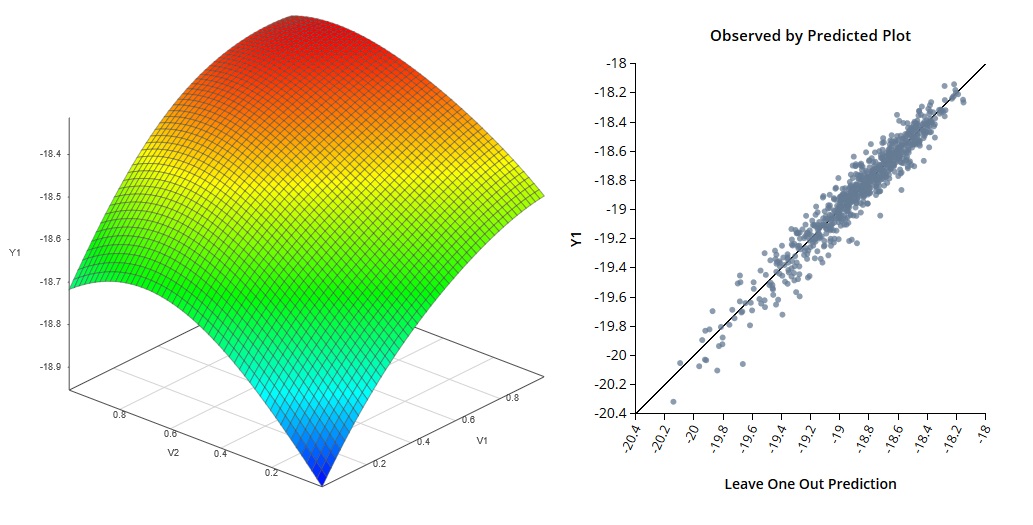
SmartUQ GUI
Interactive environment for data processing, visualization, creation of DOEs and Emulators, integration and automation of other software, and performing analytics (i.e. Uncertainty Propagation, Sensitivity Analysis, Inverse Analysis, Statistical Calibration, and Statistical Optimization).
-
Prediction GUI
Interactive environment for using previously trained models to perform predictions.
-

Analytics GUI
Interactive environment for using previously trained SmartUQ models to perform data processing, visualization, sensitivity analysis, optimization, and uncertainty propagation.
Programing Interfaces
-
PySmartUQ API
PySmartUQ is an extensive Python application programming interface with similar features to the SmartUQ GUI. This API is used for automation, scripting, complex workflow creation, and interfacing with other software to fit emulators and run analytics.
import pysmartuq def borehole(x): # define borehole simulation... x = pysmartuq.doe.lhd(800, lb=lower_bound, ub=upper_bound) y = borehole(x) emu = pysmartuq.emu.Fast(nugget=0).fit(x, y) # predict the response and the variance of the response y, var = emu.predict(x, return_variance=True) -
Python Runtime API
Runtime API is a Python application programming interface that enables users to programmatically use previously trained SmartUQ emulators to make predictions. This API is designed to provide a way to distribute emulators for use within other workflows and software.
import smartuq_rt as pysmartuq

emu = pysmartuq.emu.load('path/to/emulator.smartuq')

# predict the response and the confidence intervals
y, lb, ub = emu.predict(x, ci=.995)
Packages
-
SmartUQ Pro
SmartUQ Pro combines the SmartUQ GUI, PySmartUQ API, and Runtime API allowing easy access to SmartUQ features withing Python.
-
SmartUQ Pro Plus
SmartUQ Pro Plus adds the Prediction GUI and Analytics GUI to SmartUQ Pro.
Add-on Modules
-
Varying Geometry Module
The Varying Geometry Module allows the user to build advanced Emulators for complex varying geometry problems. Typical uses include building Spatial-Temporal Emulators of simulations with inconsistent mesh or topology or from physical sampling across non uniform points.