Machine Learning and Uncertainty Quantification for Automotive Design and Manufacturing
Modern automotive engineering spans structural systems, vehicle dynamics, thermal management, powertrains, electronics, and manufacturing processes. Engineers must optimize performance, durability, safety, and cost while accounting for variability in materials, operating conditions, and customer usage. SmartUQ's machine learning and uncertainty quantification (UQ) tools help automotive teams accelerate development, reduce testing costs, and make more informed design decisions.
Why SmartUQ for Automotive Engineering?
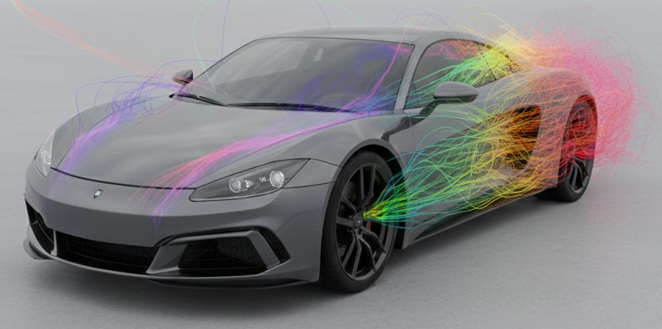
- Reduce costly testing and simulation: Automotive simulations—crash FEA, multibody dynamics, aerodynamics CFD, and thermal models—often require high fidelity computationally expensive models. SmartUQ’s efficient Design of Experiments (DOE) methods minimize required number of simulation and test runs while maximizing the insight gained.
- Fast, Accurate Surrogate Models: SmartUQ builds surrogate models that predict the results of complex automotive simulations at a fraction of the computational cost, enabling rapid design exploration and optimization across systems such as chassis, powertrain, thermal loops, and electronics.
- Quantify and Manage Uncertainty: SmartUQ provides tools for uncertainty propagation and sensitivity analysis, helping engineers understand how manufacturing variation, environmental conditions, or material differences impact performance, durability, or safety.
- Optimize Under Uncertainty: Engineers can identify robust vehicle designs, calibration settings, and control parameters even when inputs vary widely. Considering significant sources of noise and changing operating conditions while optimizing designs results in improved real-world performance.
- Calibrate Digital Twins: SmartUQ refines simulation models using test or field data, improving predictive accuracy for digital twins in areas such as durability tracking, thermal management, or powertrain monitoring.
Key Automotive Application Areas
- Thermal Management: SmartUQ accelerates modeling of engine cooling loops, inverter/motor cooling, HVAC systems, and underhood thermal behavior. Surrogates allow rapid evaluation of design variations and environmental conditions.
- Structural Durability & Crash: Surrogate-based crash and durability modeling enables broader exploration of geometries, materials, joints, and weld parameters while reducing expensive FEA runs.
- Vehicle Dynamics & Ride/Handling: SmartUQ supports tuning of suspension parameters, bushing properties, steering systems, and sensor/control strategies by building fast surrogates of multibody dynamics models.
- Powertrain & Propulsion Systems: Applications include engine parameter tuning under uncertainty, hybrid/EV powertrain efficiency analysis, NVH modeling, and drivetrain robustness assessment.
- Manufacturing & Process Engineering: SmartUQ helps optimize stamping, casting, welding, coating, and assembly processes by quantifying variation and linking it to downstream vehicle performance.
SmartUQ Empowers Automotive Engineers:
Explore more design options, reduce development cost, improve robustness, and accelerate innovation across the vehicle lifecycle..
Request a Demo
Learn how SmartUQ can accelerate you workflow. Request a free trial or contact us today.