Accelerating Battery Innovation with Machine Learning and Uncertainty Quantification
Electric vehicle battery development requires innovation under uncertainty. Engineers must balance performance, safety, cost, and lifecycle constraints, all while accounting for variation in environmental conditions, manufacturing, and usage. SmartUQ's machine learning and uncertainty quantification tools empower engineers to accelerate design cycles and make data-driven decisions with confidence.
Why SmartUQ for EV Batteries?
- Reduce costly testing and simulation: Use modern Design of Experiments to minimize the number of simulations and experiments required.
- Build fast, accurate surrogate models: SmartUQ's machine learning models replicate expensive battery simulations (e.g. electrochemical, thermal, structural) at a fraction of the time.
- Quantify uncertainty: Evaluate the impact of uncertain conditions (e.g. ambient temperature, material variability) on battery performance and safety.
- Optimize under uncertainty: Identify optimal battery designs, control strategies, or recipes even in the presence of variability.
- Calibrate digital twins: Improve real-time battery monitoring and prediction by calibrating models with field or test data.
Application Areas
- Thermal Management: Model and optimize battery cooling systems under uncertainty in ambient conditions and coolant flow rate.
- Cell Chemistry and Degradation: Use surrogate models to accelerate evaluation of discharge curves and capacity fade across cycles.
- Reliability and Lifetime: Propagate uncertainty in usage and environment to predict battery life distributions and failure risk.
- Battery Management System (BMS) Design: Evaluate control strategies with sensitivity analysis and uncertainty propagation.
Case Study: Battery Thermal Simulation
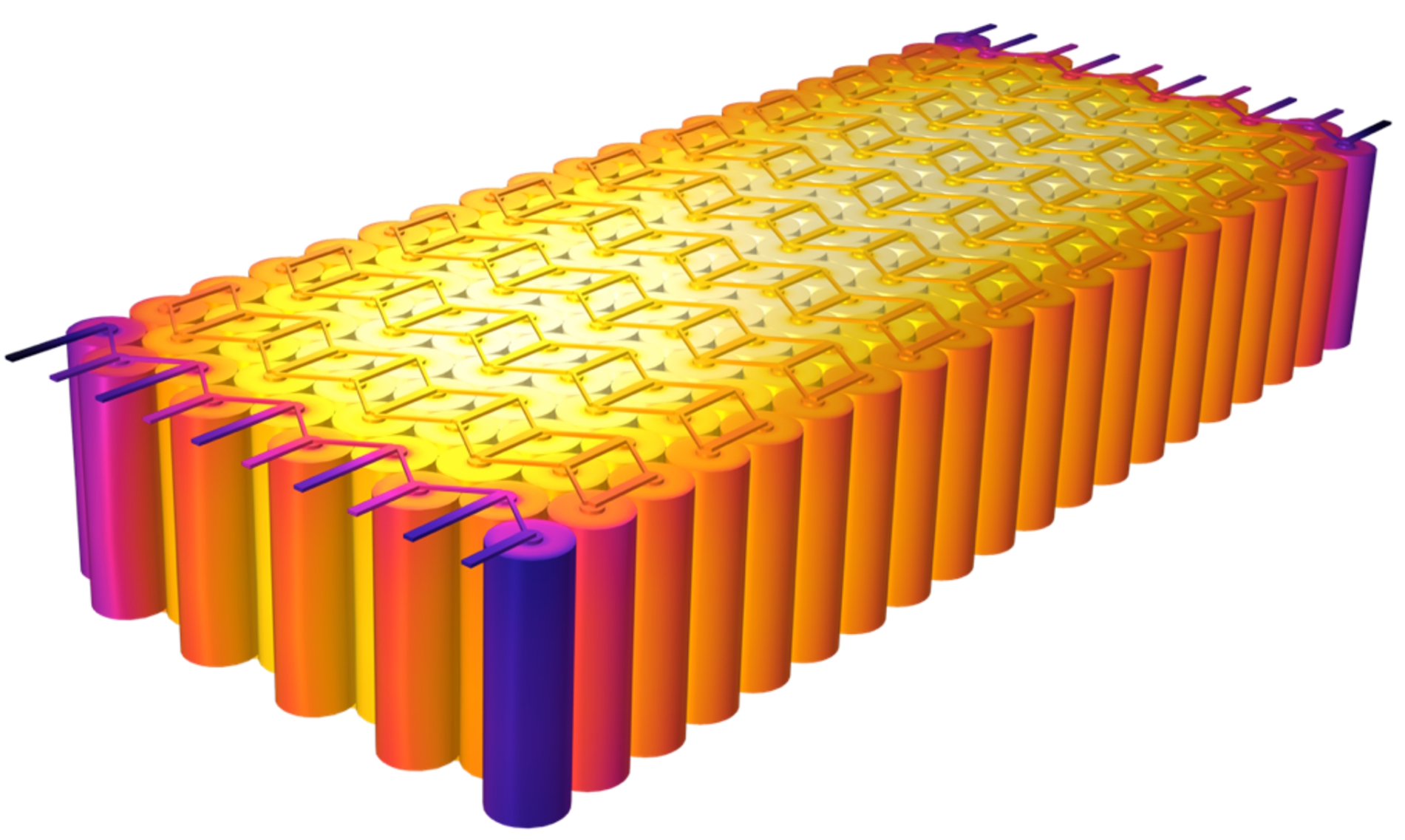
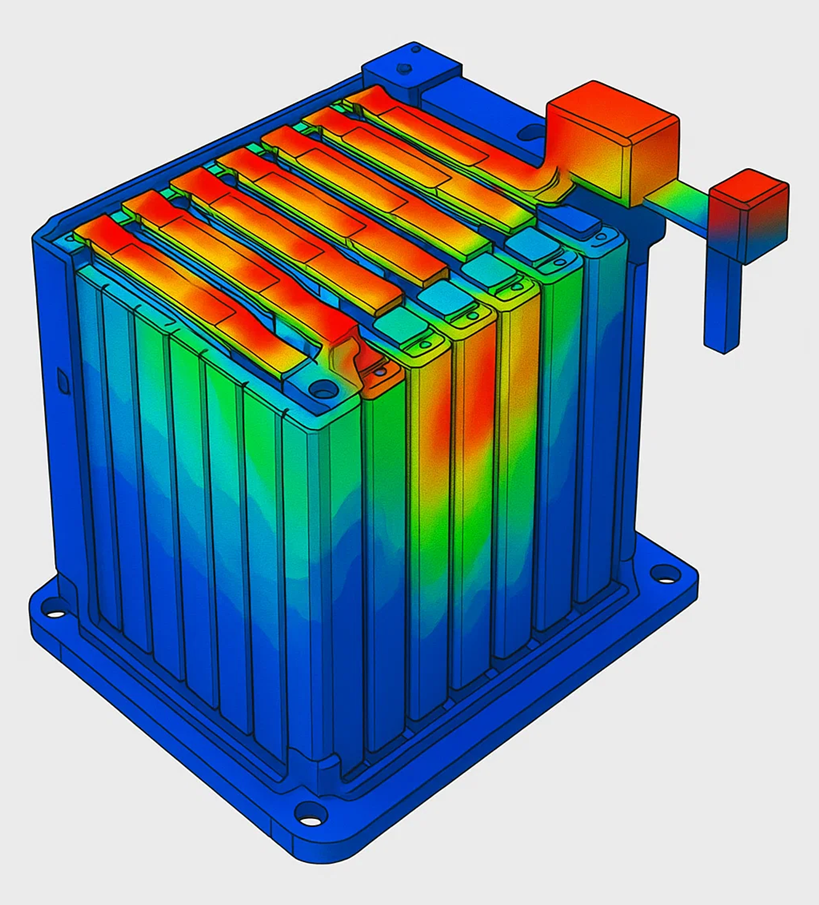
In one application, a COMSOL simulation was used to evaluate the maximum battery cell temperature under varying coolant flow rate, thermal conductivity, and ambient temperature. SmartUQ trained an accurate surrogate model on 60 simulation runs and validated it with an additional 30 runs. The resulting model enabled efficient uncertainty propagation and stochastic optimization to evaluate design trade-offs in thermal management system (BTMS) performance. The model was also used to conduct simulation parameter calibration to physical data.
SmartUQ Software Capabilities
- Design of Experiments: Efficient sampling methods including Latin Hypercube, sliced/nested designs, and adaptive designs.
- Machine Learning Modeling: Specialized GP-based models for high-dimensional, temporal, and functional battery simulation outputs.
- Model Calibration: Frequentist and Bayesian calibration to reconcile simulation predictions with experimental or field data.
- Analytics: Tools for sensitivity analysis, uncertainty propagation, and robust or reliability-based optimization.
- Integration: Interfaces for Python, MATLAB, FMUs, and direct connections to simulation platforms like COMSOL and ANSYS.
Build Digital Twins for EV Batteries
SmartUQ enables the creation of real-time digital twins by combining calibrated surrogate models with sensor data. This supports predictive maintenance, charge/discharge control, and lifespan extension for battery systems.
Request a Demo
Learn how SmartUQ can streamline your battery R&D workflow. Request a free trial or contact us today.